
PLATE & SHELL HEAT EXCHANGERSHeating · Cooling · Condensation · Heat recovery

Search JINCHEN

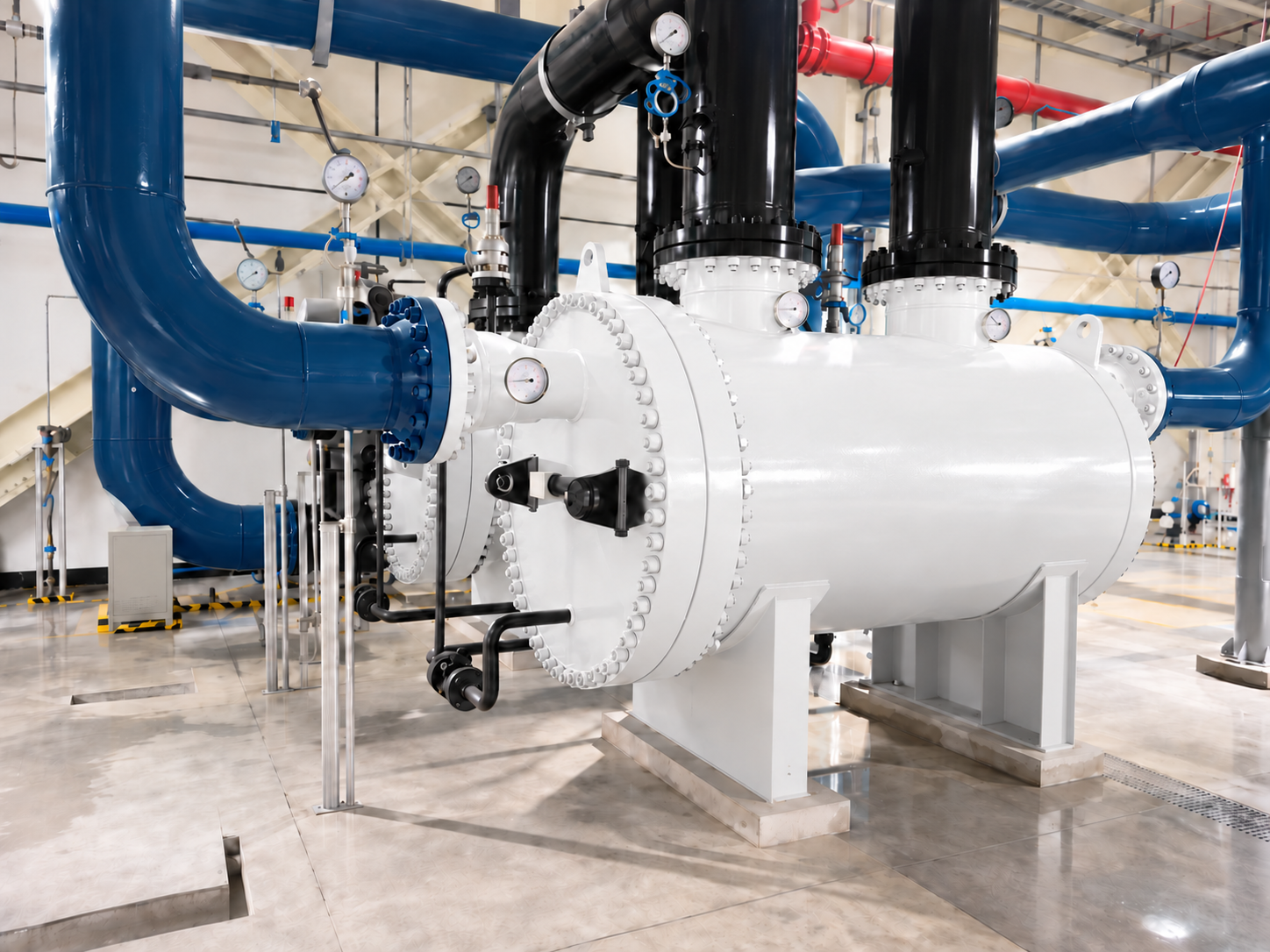
JINCHEN shell and plate heat exchanger installed in an industrial piping system
JINCHEN / APPLICATIONS

Heating, cooling and phase change.

Start with the process duty. Then select the plate pack, shell configuration, materials and flow arrangement.

01 / PSHE

Liquid heating & cooling

Process liquids, oils and condensates. Review viscosity, fouling and allowable pressure drop.

Selection considerations

  • Liquid properties and viscosity
  • Thermal duty and temperature approach
  • Fouling and cleaning strategy
02 / PSHE

Gas heating & cooling

Gas-side flow and nozzle dimensions selected around the required duty and pressure drop.

Selection considerations

  • Gas volume and nozzle sizing
  • Allowable pressure drop
  • Condensation risk and operating range
03 / PSHE

Condensation

Steam and process-vapour condensation, including seawater-cooled service with appropriate materials.

Selection considerations

  • Vapour composition and cooling medium
  • Condensate handling
  • Material compatibility
04 / PSHE

Evaporation

Process evaporation, reboilers and kettle-type configurations selected for the operating conditions.

Selection considerations

  • Boiling conditions and circulation
  • Shell-side volume and separation
  • Operating range and control

Detailed application scenarios

Explore the process objective and engineering questions for each duty. These are application guidance, rather than customer project references.

Crude oil cooling and heating

Process duty

Cool export crude with a water circuit, or heat crude before separation and transfer.

Selection considerations

Review viscosity at the actual operating temperature, wax appearance temperature, solids and minimum wall temperature. Counter-current flow is not always the best choice: a co-current arrangement may be evaluated to limit local overcooling.

Explore the engineering principles → · View this duty →

Lean / rich TEG and amine heat recovery

Process duty

Transfer heat from regenerated lean solvent to the rich stream before regeneration; use a separate cooler where the absorber needs a lower inlet temperature.

Selection considerations

Specify solvent concentration, contaminants, approach temperatures, pressure difference between circuits and corrosion conditions. Solvent chemistry and cleaning compatibility govern material selection.

Explore the engineering principles → · View this duty →

Feed / effluent heat recovery

Process duty

Recover heat from a hot process outlet to preheat incoming feed, reducing the load on the final heater.

Selection considerations

For polymerising or temperature-sensitive fluids, examine residence time and wall temperature as well as bulk outlet temperature. Turbulence may help limit deposition, but does not eliminate fouling; cleaning access and filtration remain important.

Explore the engineering principles → · View this duty →

Compressor interstage and suction cooling

Process duty

Remove compression heat before the next stage or condition the suction gas using water, glycol or a compatible cooling circuit.

Selection considerations

Review gas composition, pressure loss, dew point and liquid carryover. Cooling can cause condensation, so the exchanger and downstream separator must be considered together.

Explore the engineering principles → · View this duty →

Boil-off gas warming

Process duty

Warm cold vapour before downstream handling, using a suitable heating utility.

Selection considerations

Define the full inlet-temperature range, utility control, startup sequence and differential thermal expansion. Low-temperature toughness and avoidance of local freezing require project-specific review.

Explore the engineering principles → · View this duty →

Process and overhead condensation

Process duty

Condense reactor or column overhead vapour and remove latent heat into a cooling circuit.

Selection considerations

Identify mixture composition, condensing temperature glide, non-condensable gases, vacuum conditions and condensate drainage. Allowable vapour pressure drop may control the channel and connection arrangement.

Explore the engineering principles → · View this duty →

Ammonia / CO₂ cascade refrigeration

Process duty

Condense the lower-temperature refrigerant while evaporating the higher-temperature refrigerant in a separate circuit.

Selection considerations

Both sides undergo phase change. Review refrigerant charge, distribution, liquid level, oil management and pressure differential in normal operation and shutdown. The cascade temperature approach affects both stages.

Explore the engineering principles → · View this duty →

Flooded and direct-expansion evaporation

Process duty

Cool a water or glycol circuit through refrigerant evaporation. Flooded and direct-expansion systems require different feed and separation arrangements.

Selection considerations

For flooded duty, review circulation and liquid level. For direct expansion, review inlet distribution and outlet superheat. Check freezing risk, minimum flow, part-load stability and oil return in both cases.

Explore the engineering principles → · View this duty →

Process reboiling and steam transformation

Process duty

Use a heating utility to boil a process liquid or generate a secondary vapour stream.

Selection considerations

Review boiling pressure, liquid inventory, vapour disengagement and circulation. Kettle-type integration or an external separator is a system design choice, not an assumed option for every model. Confirm the available configuration during selection.

Explore the engineering principles → · View this duty →

Send your operating conditions

Send Your Process Data for Heat Exchanger Selection

Provide both fluids, flow rates, inlet and outlet temperatures, operating and design pressures, allowable pressure drop and material requirements. For an existing installation, include the nameplate and arrangement drawing.

Send Your Process Data